

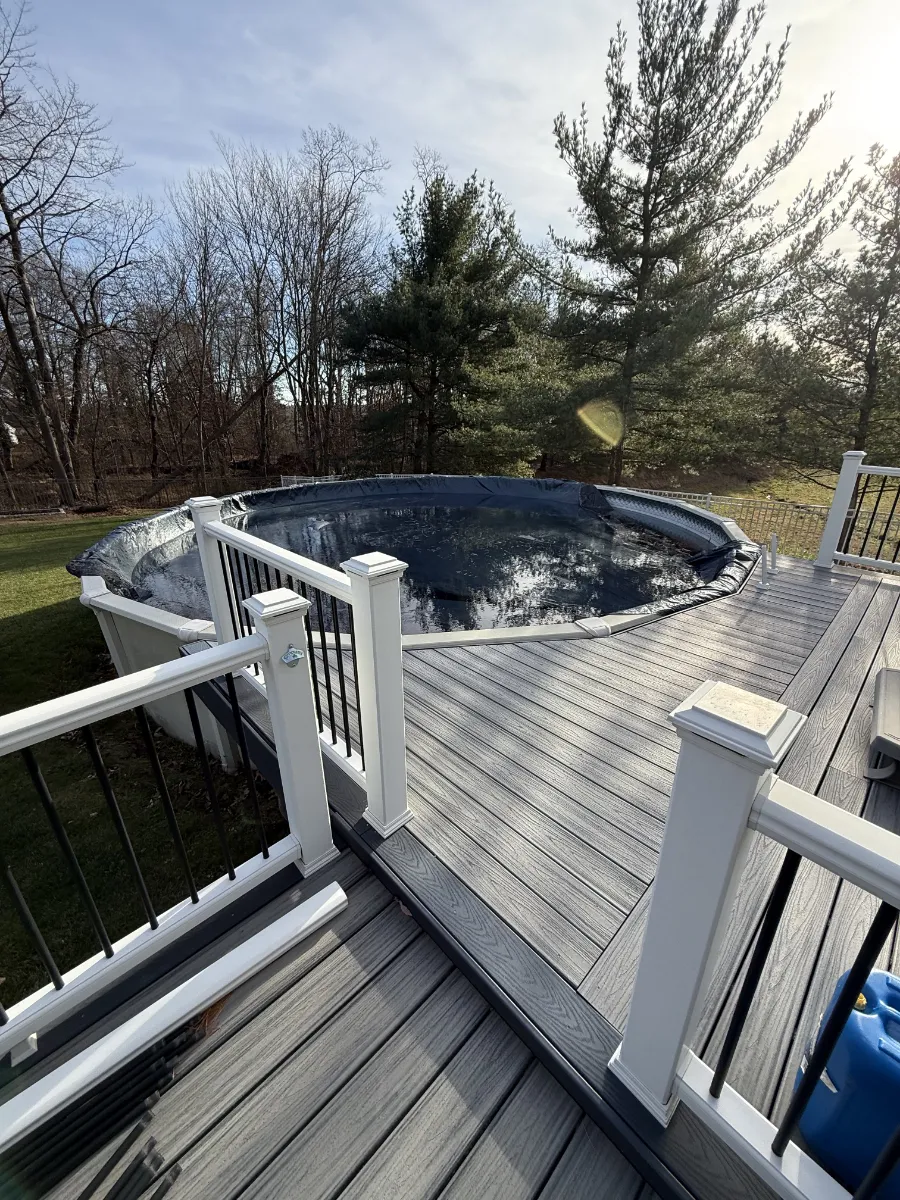

A tired-looking deck is not always an unsafe one, and a deck that looks fine on top can have real problems underneath. Before deciding between a repair and a full replacement, it helps to know what to look at, where decks usually fail, and what today’s guidance expects from a deck that is attached to a house.
This guide is meant to help you take a first look and ask better questions. It is not a substitute for an inspection by a qualified professional, especially on an elevated deck.
Where to look first: the ledger
The ledger is the board that attaches the deck frame to your house. According to the American Wood Council (AWC), data collected on deck failures since 2001 shows that one of the primary reasons decks collapse is a ledger connected to the house with nails only, instead of properly installed bolts or lag screws. The AWC’s guidance is that the ledger should be positively connected to the house floor structure with bolts or lag screws, not nails.
The quick check the AWC suggests: look at the face of the ledger. If you only see nail heads, you most likely have a nailed-only ledger. The AWC says a deck like that should be treated as unsafe, kept out of use, and repaired or replaced based on the recommendations of a qualified designer or construction professional.
Even when bolts or lag screws are present, their size, spacing and length matter. The AWC notes that since the 2009 edition, the International Residential Code (IRC) has required the ledger to be connected to the house band joist with 1/2-inch bolts or lag screws, with spacing that depends on the deck’s joist span. If you can see the inside of the band joist from a basement or crawlspace, the tip of a properly sized lag screw should be visible past its inside face. If it is not, the AWC recommends having a qualified professional investigate.
Flashing at the ledger
Flashing keeps water from reaching the house band joist behind the ledger, where damage is hard to see. The AWC’s deck construction guide calls for the house siding to be removed where the ledger goes and for corrosion-resistant flashing at any ledger attached to a wood-framed wall. It also cautions that aluminum flashing should not be used where it will touch treated lumber, because some preservatives contain copper that corrodes aluminum.
Attachments that are not allowed
The same guide prohibits attaching a ledger to brick, stone or other exterior veneers, to hollow masonry, or to cantilevered floor overhangs and bay windows. In those situations, a deck that is supported on its own posts and beams is required instead. Lead anchors are also prohibited for ledger fasteners.
Signs of rot and wear
The North American Deck and Railing Association (NADRA) publishes a 10-point consumer deck safety checklist. Its first item is split or decaying wood: probe the ledger, posts, joists, deck boards, railings and stairs. Wood that a tool sinks into easily, roughly 1/4 to 1/2 inch, or wood with small insect holes may be rotting.
Other points from NADRA’s checklist worth checking:
- Loose or corroded fasteners: popped nails or screws, and rusted anchors, especially at the ledger.
- Stability: the deck should feel solid, without sagging or sway.
- Railings: guardrails should be firmly secured, especially on elevated decks.
- Stairs: handrails and stringers secure and risers intact.
- Flashing: the guard at the house-deck junction should direct water away and be firmly in place.
The AWC adds that railings and stairs are just as important to deck safety as the ledger, and that all decks, especially elevated ones, should be inspected regularly by a qualified inspector or construction professional.
Footings and posts
The AWC’s Prescriptive Residential Wood Deck Construction Guide (DCA 6), a free document based on the 2015 IRC for single-level residential wood decks, says footings should bear on undisturbed soil at least 12 inches below the undisturbed ground surface or below the frost line, whichever is deeper. The local building department sets the frost line. The guide also says to call 811 before digging so underground utilities can be marked.
When you look at your deck’s footings and posts, watch for:
- Posts that lean, have settled, or sit directly on the ground or on loose blocks.
- Soft or split wood at the base of posts.
- Rusted post bases or connectors.
Hardware matters too. DCA 6 calls for screws, bolts, nails and washers used with preservative-treated wood to be hot-dipped galvanized, stainless steel, silicon bronze or copper. Badly rusted connectors on an older deck are a warning sign.
Repair or replace?
A repair may be reasonable when
- Damage is limited to a few deck boards, a stair tread or a section of railing.
- The ledger is properly bolted or lag-screwed and flashed, with no rot behind it.
- Joists, beams, posts and footings are sound when probed and checked.
Replacement is usually worth considering when
- The ledger is nailed-only, rotted, or attached to something it should not be, such as brick veneer.
- Rot shows up in several joists, the beam or the posts.
- Footings are shallow, settling or missing.
- Railings and stairs need to be rebuilt anyway and the framing is aging.
- You want a different size, layout or material, and the existing framing would not support it.
Some decks fall in between. If the framing is in good shape, it can sometimes be kept while the surface boards and railings are replaced. That decision should only be made after the structure has been checked, because new boards on a failing frame do not fix the frame.
Composite or wood?
If you are replacing the deck surface, the main choice is wood or composite boards. In general terms:
- Wood (often pressure-treated lumber) is the traditional choice. NADRA’s checklist recommends keeping it clear of debris and reapplying waterproofing coatings as needed.
- Composite boards are made to reduce routine upkeep. Trex, for example, says its decking should never be sanded and that painting or staining it is not recommended and may void its fade and stain warranty, and that soap and water handles routine cleaning on its current boards.
One point that is easy to miss: composite boards still sit on a structural frame. Trex lists pressure-treated lumber or steel as the recommended framing for its decking. So even with composite on top, the ledger, flashing, joists, posts and footings described above still matter.
You can see more about how we approach new decks and rebuilds on our decks page.
Frequently asked questions
How can I tell if my deck is nailed to the house?
Look at the face of the ledger board where the deck meets the house. The American Wood Council says that if only nail heads are visible, you most likely have a nailed-only ledger, which it considers potentially dangerous. Have a qualified professional evaluate it before using the deck.
How do I check for rot?
NADRA suggests probing the ledger, posts, joists, deck boards, railings and stairs. Wood that a tool sinks into easily, roughly 1/4 to 1/2 inch, or that shows small insect holes may be rotting.
Can I put new boards on my old deck frame?
Sometimes, if the frame, ledger connection, flashing and footings are sound. That should be confirmed by a careful inspection first, because new decking does not fix problems in the structure below.
Does a composite deck need a different frame?
Composite boards still need a structural frame. Trex, for example, recommends pressure-treated lumber or steel framing. Always follow the specific manufacturer’s installation requirements.
If you are unsure whether your deck needs a repair or a rebuild, we are happy to take a look. Request a free estimate, or see our other exterior remodeling services.